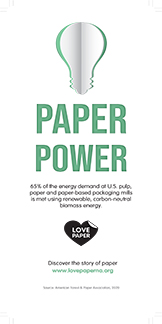
"Made from a renewable resource." "Responsible sourcing." "Circular product." "Green." "One of the most recycled materials."
We hear this at work and we see it on our packaging at home. We are continually reminded that running a modern mill requires a constant balance between renewable fiber sources, high energy demands, and growing expectations for a lower environmental impact.
The pulp and paper industry has made significant environmental progress over the years. In just a generation or two, the transformation has been outstanding - with impressive advances even in the last five to ten years.
With this in mind, let's examine the environmental performance of our mills: the day-to-day challenges operators face, the real gains achieved through sustained investments, and the practical steps that can be taken. Because the modern world continues to rely on the essential products our mills make.
Operational Challenges
Regardless of what type of mill you have (kraft, recycle, tissue,...) mill teams must meet production goals while handling permitting requirements, capital investment decisions, and constantly shifting market conditions. But there's more...
Recent years have brought additional pressures (naturally). On the recycling front, 2024 U.S. paper recycle rates reached 60-64 percent for paper and 69-74 percent for cardboard. These numbers are favorable, but with reduced exports of recycled paper, this number will be lower after 2024.
(Personally, it seems a bit odd to take recycled paper, use fossil fuels to ship it across an ocean, and count that as being "green", but I'm not the one adding those numbers.)
Moving onward, EPA data for 2023 indicates the sector reported approximately 31.7 million metric tons of CO₂ equivalent in fossil greenhouse gas emissions across roughly 208-222 facilities. This is a potential area for more improvement.
The bottom line for all these operational challenges is that long timelines for permits, environmental goals, and reliable uptime all must be harmonized in order to truly improve environmental outcomes. (Hello, Project Managers!)
Measurable Progress
Emissions: Some pulp and paper mills have achieved major environmental improvements thanks to specific capital projects, and elbow grease. The result? Reduced greenhouse gasses in some mills. According to the latest American Forest and Paper Association (AF&PA) progress update, member facilities achieved a 36% reduction in Scope 1 and 2 greenhouse gas (GHG) emissions from 2005 through 2022.
Scope 1: Direct Emissions
These are GHG emissions generated at facilities directly owned or operated by the company.
Scope 2: Indirect Emissions
These emissions are associated with the generation of purchased electricity and steam.
Much of the 36% reduction mentioned above comes from upgrades to energy systems, better heat recovery, and a continued reliance on biomass residuals for a substantial portion of mill energy needs.
Recycling: Industry wants to utilize 50% recycled fiber. In 2024 in the U.S., they got more - approximately 46 million tons of recycled paper (60-64%). This much recycled fiber, naturally, requires ongoing investments in screening, cleaning, and refining equipment to maintain product quality while reducing reliance on virgin fiber.
Water Stewardship: Additional progress can include advances through more efficient closed-loop systems and site-specific watershed practices, as well as using more / a lot of certified fiber from healthy, managed forests.
Safety: Most important of all, are the safety initiatives that aim for zero serious injuries. These, in the AF&PA goals, also reinforce a culture of operational excellence where environmental performance and reliable production go hand-in-hand.
Innovations and Realistic Paths Forward
The road ahead for pulp mills involves practical, mill-specific solutions. A few examples are:
- Energy efficient upgrades: improving dewatering, steam system optimizations, and advanced process controls all continue to offer some of the most immediate and cost-effective ways to lower emissions.
- Where grid conditions and economics allow, selective electrification of support systems can play a supporting role, though many mills need to continue to rely heavily on their existing fuel sources.
- Longer-term opportunities include exploring biomass energy paired with carbon capture technologies in regions where infrastructure and incentives align, as well as testing low-carbon fuel options.
Each pathway must be evaluated against capital costs, permitting timelines, and (especially) reliability.
The big picture is that the pulp and paper sector has made significant strides delivering renewable paper-based products with substantial recycled content through decades of focused investment.
And continued success at the mill will depend on ongoing collaboration between work teams, suppliers, and policymakers, so that becoming more circular, recycled, or green is both environmentally effective as well as financially and operationally achievable.
See you next month when we discuss Transportation. |